Water and wastewater technology

Protecting resources, securing the future
Clean water is a fundamental element for existence, a human right and also a central economic factor. But this resource is currently threatened worldwide. Around a third of the global population already has no permanent access to clean drinking water. At the same time, insufficient wastewater treatment, ailing infrastructure and the impacts of climate change are worsening the situation. The Export Initiative Environmental Protection (EXI) supports the creation of sustainable water systems all over the world using German environmental technology, thus contributing considerably to the UN Sustainable Development Goals (SDG 6).
Contact
Export Initiative Environmental Protection +49 30 72618 0999 Email
Global challenges: Why we have to act
Global challenges: Why we have to act
The United Nations has issued a warning: by 2050, more than five billion people could suffer from water shortages.1 Already, around 80 percent of wastewater enters rivers, lakes and seas2 untreated, resulting in grave consequences for ecosystems and health. People in the Global South3 are particularly affected. In sub-Saharan Africa, the demand for water is expected to rise by 163 percent by 2050.3 Already, 42 percent of households in 15 major cities of the Global South have no access to tap water. Since 1990, the number of urban inhabitants without such access has increased by over 200 million.4 Worldwide, 2 billion people, which represents 26 percent of the global population, are living without access to safe drinking water.5
The hidden costs of polluted water
The economic damage caused by insufficient wastewater treatment is substantial.6 Brazil loses 16 billion US dollars every year in agriculture due to contaminated irrigation water, India more than 2 billion US dollars in the fisheries sector and 246 million US dollars in illness-related healthcare costs.6
A thirsty sector: water needs energy
At the same time, water and wastewater plants in many municipalities are among the largest electricity consumers and amount to as much as half of the total electricity bill.7 Globally, four percent of electricity consumption are already attributable to the sector – an amount that is likely to double by 2040.7,8 In addition, the sector consumes the energy equivalent to 50 million tonnes of oil, primarily in the form of diesel for irrigation pumps and natural gas for desalination plants.8
When wastewater makes people ill and ecosystems break down
Untreated wastewater has serious impacts on ecosystems and health.9 Excess nutrients such as nitrogen and phosphorus lead to the eutrophication of waters, resulting in algae blooms and ‘dead zones’ caused by lack of oxygen, where aquatic life is no longer possible10 Risks to human health arise from the contamination of food chains, skin diseases of agricultural workers as a result of direct contact, and the spreading and development of dangerous pathogens in polluted waters.11
Infrastructure losses and growing risks
Furthermore, large amounts of valuable drinking water are lost in many countries due to leaking pipes.12 If these developments are not slowed down, many regions will be threatened by supply bottlenecks, health risks and conflicts relating to the use of this vital resource.
The contribution of the Export Initiative Environmental Protection (EXI)
The Export Initiative Environmental Protection (EXI) tackles exactly these challenges. It promotes the transfer of German knowledge and sustainable technologies in order to support partner countries in the development of stable and resource-saving water systems. The focus here is on solutions that are ecologically feasible, economically viable and operable in the long term.
These include the reduction of pipe losses, the recycling of water in agriculture and industry, the improvement of access to clean drinking water, and the modernisation of existing systems. Equally important are measures to protect waters from pollutant inputs, strategies for the adaptation to droughts or torrential rain events, and the recovery of resources such as phosphorus, biogas or metals from wastewater. The EXI thus helps to secure water resources in the long term, make supply more stable and infrastructure more resilient to the impacts of climate change.
EXI activities in the water and wastewater field of action
Since its launch in 2016, the Export Initiative Environmental Protection (EXI) has furthered 66 projects worldwide in the water and wastewater area, with a total funding volume of EUR 13.76 million. The projects range from innovative methods of drinking water purification and energy-efficient wastewater treatment to concepts for the recycling of water in industry and agriculture.
The EXI funds various types of projects with clear priorities: feasibility studies investigate the technical and economic aspects of innovative water technologies in specific markets. Pilot and model projects demonstrate German environmental technologies under realistic in-situ conditions. In turn, capacity-building projects train local actors in the operation and management of sustainable water systems.
Special funding areas comprise the creation and adaptation of technical plants, physical infrastructure and experimental research with an investment component. For example, the CANOPUS project in Egypt is working with an integrated approach on making seawater desalination more environmentally friendly, whilst the ANAJO project in Jordan is developing innovative solutions for water recycling in one of the countries with the highest shortage of water in the world. The HEALTH project in Laos concentrates on the improvement of water supply in healthcare facilities whilst at the same time strengthening the climate resilience of the healthcare system.
A key feature is the close cooperation with local partners, ensuring that solutions are adapted to local conditions and can be operated in the long run. Projects in countries such as Chile, India, Jordan, South Africa and Tanzania demonstrate how German environmental technology helps to secure water resources, mitigate climate risks and create new economic prospects.
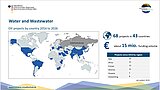
In Asia, a regional focus is emerging for this topic area: 23 projects were realised there over the entire funding period. This concentration can be explained by the specific challenges of the region: Vietnam is battling with industrial pollution and urban wastewater pollution, while India, as one of the world’s largest pharmaceutical producers, needs innovative solutions for highly contaminated industrial wastewater. For example, a pilot plant for the treatment of toxic pharmaceutical wastewater was put into operation in the pharmIn2 project in Hyderabad. Furthermore, the EXI is implementing projects for sustainable urban development and industrial water reuse in Vietnam, where German environmental technologies are adapted to specific climatic and infrastructural conditions.
The investment component in the water and wastewater area
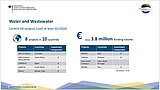
Since 2021, the EXI has funded a total of 15 projects with an investment component in the water and wastewater area. With a total funding volume of around EUR 8.1 million, these projects are testing and demonstrating innovative German environmental technologies in 19 countries. These projects go beyond standard feasibility studies and comprise the creation, expansion or adaptation of technical plants and physical infrastructure on site.
The WasserWert project in Chile, for example, developed an ion exchange plant for the recovery of valuable resources such as cobalt and copper from mining waste. This results in sustainable solutions for the South American mining industry. In turn, the VINETA project is installing decentralised drinking water treatment plants in the Pacific island states of Fiji, Palau, Tonga, Kiribati and the Marshall Islands. These compact Aqua-CUBE systems, with modular low-pressure membrane filtration, can operate independently thanks to solar panels and, with durable membranes, have a service life of up to ten years.
Such practical showcases not only demonstrate what is possible under realistic conditions but, at the same time, create concrete market opportunities for small and medium-sized German enterprises in the respective target markets.
Selected projects
The selected funded projects show how the reuse of water, circular approaches and wastewater treatment work specifically – in Chile, India, South Africa and beyond.
Learn more about the topic
Publications
Feasibility Study - Adding value to renewable hydrogen from wastewater plants
Compendium “Developing a Water & Sanitation Safety Plan in a rural community ”
GESALO - Water and wastewater sector in KSA